Hi all it's your girl JA Nursing here, I hope all is well? Over the last couple of years, I have been working directly with Sickle Cell Patients in a acute care hospital setting. June 19 2016 has been proclaimed World Sickle Cell Day. As your health Health Care advocate I just wanted to continue the conversation regarding knowing your sickle cell status. Imagine finding a new partner and your question is what's your status? well add it to the convo what's your HIV and Sickle Cell status. In 2006 Canada included sickle cell to the new born screening list, which means that Parents will have a better opportunity to seek support earlier. For more information about the diseases being screened under this program, you can visit https://www.newbornscreening.on.ca/en/screening-facts/diseases-screened. It is important for individuals to understand that they may have the trait and not know it. The trait very rarely comes with signs or symptoms. Which can pose a problem when picking a partner. If you have the sickle trait and become involved with someone that has the Sickle cell trait then you can have a child that will have sickle cell disease. People with sickle cell trait do not have sickle cell disease. They cannot develop sickle cell disease later on in life but they can pass sickle cell trait to their children. If the disorder is not detected at birth, you can ask your Doctor for a special blood test called hemoglobin electrophoresis. This test is the only test that can detect Sickle cell trait or disease.
Sickle cell Disease has always been seen as "The Black Disease" due to it being very prevalent among dark skinned people and almost completely absent in "white" populations. It has been cited that sickle cell is also prevalent in the following areas: Africa,Mediterranean countries (such as Greece, Turkey, and Italy),The Arabian peninsula, India, Spanish-speaking regions (South America, Central America, and parts of the Caribbean) In each region both dark and light skinned people have been found to be sickle cell carriers.
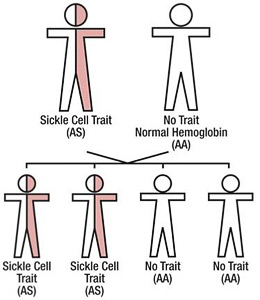
Sickle cell disease is inherited in an autosomal recessive pattern. This means that a child will not inherit the disease unless both parents pass down a defective copy of the gene. People who inherit one good copy of the gene and one mutated copy are carriers. They are clinically normal, but can still pass the defective gene to their children.According to statistics, if both parents carry a sickle cell gene, with each pregnancy there is a one in two chance the child could receive a sickle cell trait, and a one in four chance the child could be born with the actual disease.

Sickle cell disease involves the red blood cells, or hemoglobin and their ability to carry oxygen. Normal hemoglobin cells are smooth, round and flexible, like the letter "O," so they can move through the vessels in our bodies easily. Sickle cell hemoglobin cells are stiff and sticky and form into the shape of a sickle, or the letter "C," when they lose their oxygen. These sickle cells tend to cluster together and cannot easily move through the blood vessels. The cluster causes a blockage and stops the movement of healthy, normal oxygen-carrying blood. This blockage is what causes the painful and damaging complications of sickle cell disease.The two main characteristics of
If your child has sickle cell your child may appear pale and have yellow eyes from time to time. They may become tired sooner than their peers when doing an activity. So remember to develop a health action plan with your childs school and teacher. Every educator should understand how sickle cell disease can impact a child's learning. The education of the child with sickle cell anemia is just as important as it is for any child. Sickle cell anemia alone does not affect learning ability. However, excessive absence due to the complication of the disease sometimes affects a child ability to meet up with class work. Motivating and helping a child to achieve his or her potential in school is important because that child has a future. Extra encouragement and home school when they are unable to be in the classroom would be helpful when illness interferes with school. Keeping up with schoolwork is important. These efforts can make a great difference in educational achievement. The child should be encouraged into post secondary education as wel should parents learn more about solutions that will help you guide your child. JA Nursing we care is a navigation orgainization that helps to find soultions If your child has sicklecell you can get help. No one wants to feel as if their child has a diaibilty but let's work towards making thier lifes great.
The most common symptom of a sickle cell crisis is a vaso-occlusive episode join pain . Any bone can be affected, including the arms, legs, back, and skull. These episodes, commonly called pain crises, are unpredictable. It is very important for parents to communicate with their children advising them to be aware and communicate when they are not feeling well inorder to seek support immediately. Some pain crises happen without a known reason which can make crisis hard to predict.
Severe pain is the most common of sickle cell disease emergencies (acute sickle cell crises) but one or more of the following situations may have contributed to the start of the painful sickle crisis:
- Dehydration
- Lack of fluids hot weather
- hot weather
- Infection
- Fever
- Hypoxia (decrease in oxygen to body tissue)
- Bleeding
- Cold exposure
- Drug and alcohol use
- Pregnancy and stress
With summer in session, it is very important to keep your child hydrated with a lot of fluids (water). This rule should apply regardless of illness. Remember healthy habits start early with children
Is their a cure for Sickle Cell? for many accross the world including my own family memebers this still remains a question until headlines read
Calgary’s ACH using stem cell procedure to cure sickle cell anemia


Researchers at the Alberta Children’s Hospital say they are making excellent progress with a revolutionary procedure that is curing children of sickle cell anemia.Cardelia Fox (R) used to suffer from sickle cell anemia before a novel treatment involving a stem cell transplant from her sister Tamika Allen (L) cured the disorder.
"Before the stem cell transplant I felt like I was trapped," says Fox, whose sister Tamika Allen was a perfect match — a rare one in five occurrence within families. "Without this treatment I would likely still be at Foothills getting blood transfusions every month." READ FULL STORY
Sickle Cell disease If still no cure what can be done regarding treatment?
Hydroxyurea is the only drug therapy available for sickle cell disease and has been shown to prolong survival, reduce pain episodes and some of the complications. Otherwise blood transfusions when needed and pain management with nacrotics is the standard mode of treatment. Unless you have been told by a specialist that you have very mild Sickle Cell Disease, you should consider going on the drug. You are most likely to be offered Hydroxyurea because you have lots of painful crisis or Acute Chest Syndrome. It may also be offered if there is concern about damage to any of your body organs from the sickle cell disease, or as an alternative to blood transfusion treatment. Hydroxyurea is one of the medications that require special assistance for coverage. The Trillium drug plan can be used but requires your Doctor to fill out the forms. So tell a friend to tell a friend that if you do not have drug coverage in general The trillum drug plan may help even you.
Lastly if your child has sickle cell it is very important to teach your child to take charge of their health by teaching them the right choices. Generally after a child turns 18 they no longer get seen by a Pediatrician which can make Parent input difficult. Experts recommend that Parents start taking steps to learn about their medical care around age 13 or 14. Sickle Cell will always require continous awareness.
This has been watching out for your health with Michelle Smith your Health and Social Advocate. As your health Care advocate I am available to speak at your next event about a health care topic suitable for your audience. Learn more about my services


References used
http://www.children.gov.on.ca/htdocs/English/topics/specialneeds/disabilities/index.aspx
http://www.children.gov.on.ca/htdocs/English/topics/specialneeds/index.aspx
http://www.health.gov.on.ca/en/public/programs/drugs/programs/odb/odb.aspx
http://calgary.ctvnews.ca/calgary-s-ach-using-stem-cell-procedure-to-cure-sickle-cell-anemia-1.2933392
http://www.stjude.org/Images/hosp-misc-sickle2-0902.jpg
http://sicklecellanemia.ca/pdf/adult_literature.pdf
http://www.dshs.state.tx.us/newborn/parents.aspx
http://www.uhn.ca/PatientsFamilies/Health_Information/Health_Topics/Pages/blood_disorders.aspx
Download PDF
http://sicklecellanemia.ca/education/learning-for-life/hydroxyurea/